Sam
VR Experience DirectorFounder of Escape To VR, passionate about creating unforgettable VR experiences in Carlsbad. With over 5,000 parties hosted, Sam knows what makes celebrations truly special.
You’ve booked your first VR escape room. Maybe a friend dragged you into it, maybe your company planned it as a team outing, or maybe you’ve been curious ever since you saw someone flailing around in a headset on social media. Either way, you’re going in with questions: Will I get motion sick? Will I look ridiculous? Will I have any idea what I’m doing?
The short answer to all three: probably not, yes, and absolutely. VR escape rooms are designed to be intuitive for first-timers, and the brief period of feeling silly in a headset gives way to genuine immersion faster than you’d expect. But a little preparation goes a long way toward having a great experience instead of a frustrating one.
Here’s everything you need to know before your first VR escape room session.
What Exactly Is a VR Escape Room?
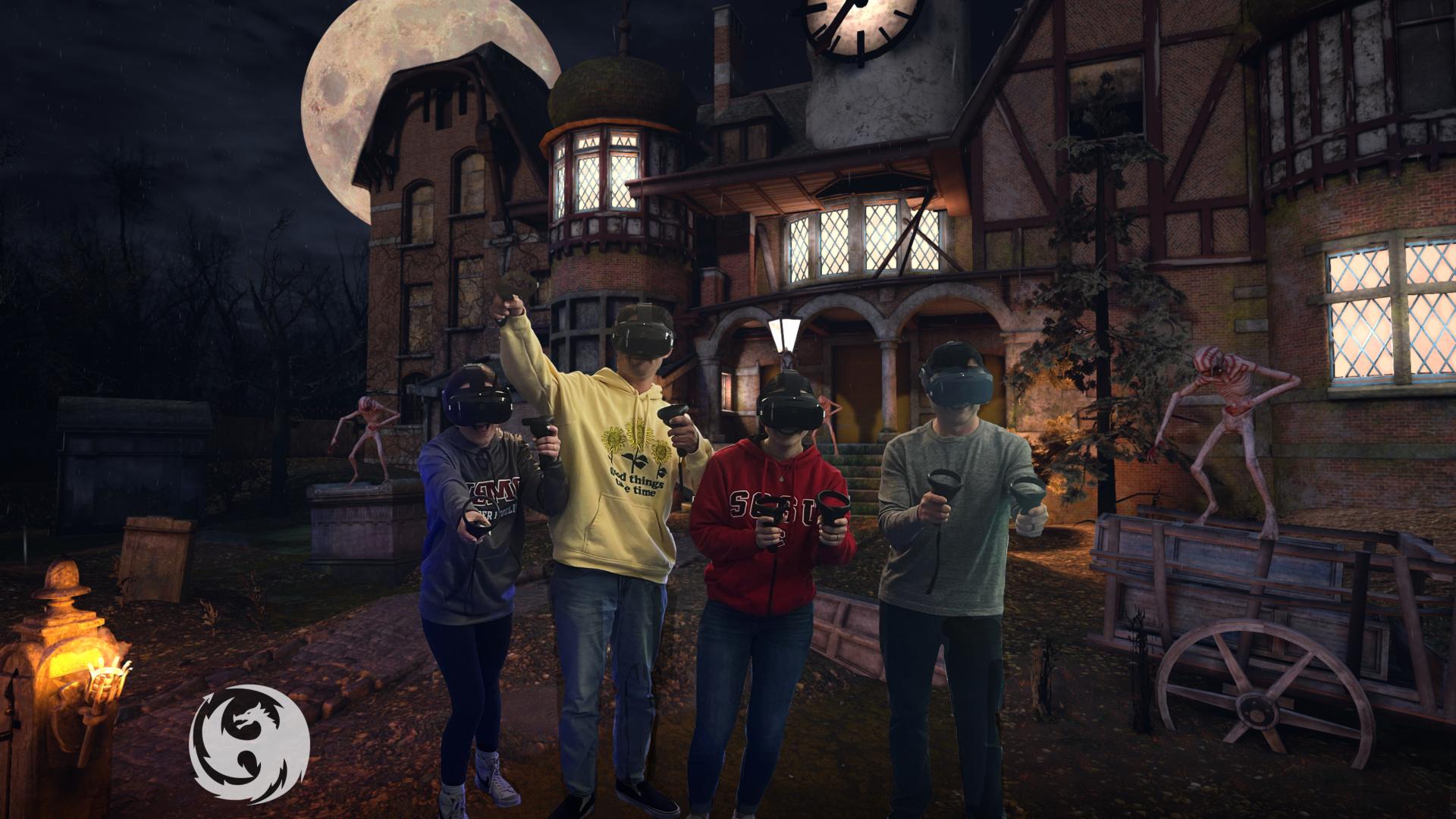
A VR escape room takes the core concept of a traditional escape room (solve puzzles, find clues, escape before time runs out) and moves the entire experience into virtual reality. Instead of being locked in a physical room with padlocks and hidden compartments, you put on a VR headset and find yourself inside a fully realized 3D environment: an ancient Egyptian tomb, a haunted manor, a pirate ship, a space station.
The key difference is scale and possibility. Physical escape rooms are limited by the size and budget of a real room. VR escape rooms can put you underwater, in outer space, or inside a building that would cost millions to construct physically. You can interact with objects that couldn’t exist in real life, and the environment can change around you in ways that a physical room simply cannot.
At Escape To VR, we use free-roam VR, which means you’re not sitting in a chair or standing in one spot. You physically walk around a large open arena while the headset tracks your movement and translates it into the virtual world. When you walk forward in real life, you walk forward in the game. When you reach out to pick up a virtual torch, your real hand moves to grab it. This physicality is what makes VR escape rooms feel genuinely immersive rather than like playing a video game.
Browse our full lineup of VR escape room games to see what kinds of environments and storylines are available.
How VR Escape Rooms Differ from Traditional Ones
If you’ve done a traditional escape room before, here’s what changes in VR:
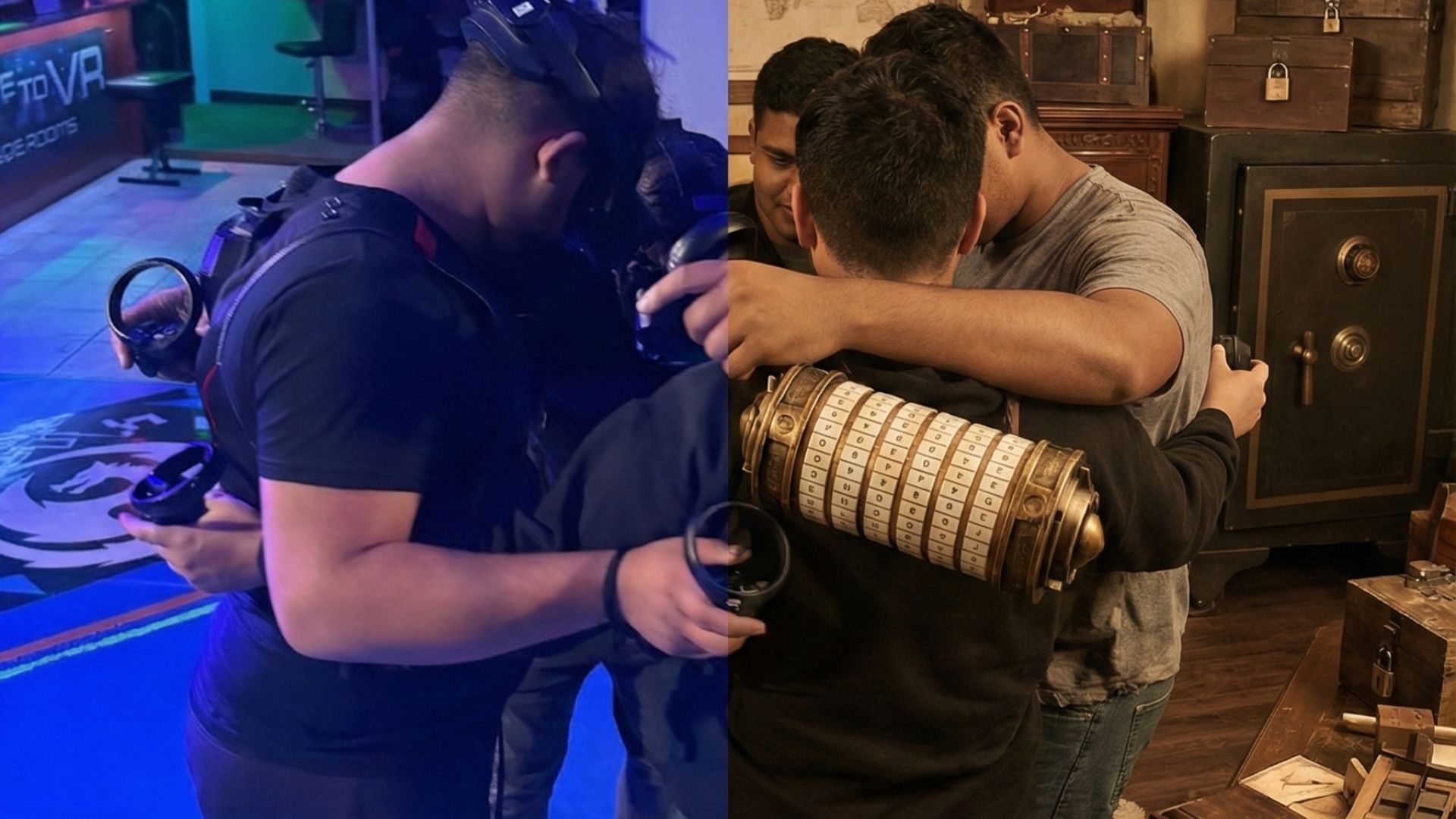
Physical space vs. virtual space. In a traditional room, every clue exists as a physical object. In VR, the environment itself is the puzzle. Walls might move, objects might transform, and the room you’re standing in might not be the same room five minutes from now.
Group dynamics shift. Traditional escape rooms often result in a few people dominating while others stand around watching. VR headsets put everyone inside the experience equally. You can’t be a passive observer when you’re physically standing in a virtual world with puzzles surrounding you on all sides.
Hint systems are more integrated. Rather than a game master speaking through a walkie-talkie, VR escape rooms often weave hints into the environment itself. Audio cues, visual highlights, and contextual clues guide you without breaking immersion.
The wow factor is real. Even experienced escape room enthusiasts tend to have a genuine moment of awe when they first look around inside a well-designed VR environment. That emotional engagement keeps your brain switched on in a way that a themed conference room rarely achieves.
For a deeper comparison, check out our full breakdown of VR escape rooms vs. traditional escape rooms.
8 Tips To Succeed in Your First VR Escape Room
1. Communicate Everything Out Loud
This is the single most important piece of advice, and the one that separates teams who escape from teams who don’t. When you find something interesting, say it out loud immediately. “There’s a symbol on this wall.” “I found a key on the table.” “This lever doesn’t seem to do anything yet.”
In VR, your teammates can’t see what you’re looking at unless they’re standing right next to you and facing the same direction. Information that seems trivial to you might be the missing piece someone else needs. Over-communicating is almost impossible in a VR escape room. Teams that talk constantly outperform teams with stronger puzzle-solving skills who stay quiet.
2. Look Everywhere, Including Up and Down
New players almost always forget to look up. And down. And behind them. Virtual environments are fully three-dimensional, which means clues can be hidden on ceilings, under tables, behind paintings, or in places you would never think to check in a physical room. Make it a habit to scan every surface of every new area you enter. Crouch down and look under things. Tilt your head back and check the ceiling. Some of the best puzzle designs reward players who explore spaces thoroughly rather than rushing forward.
3. Divide and Conquer
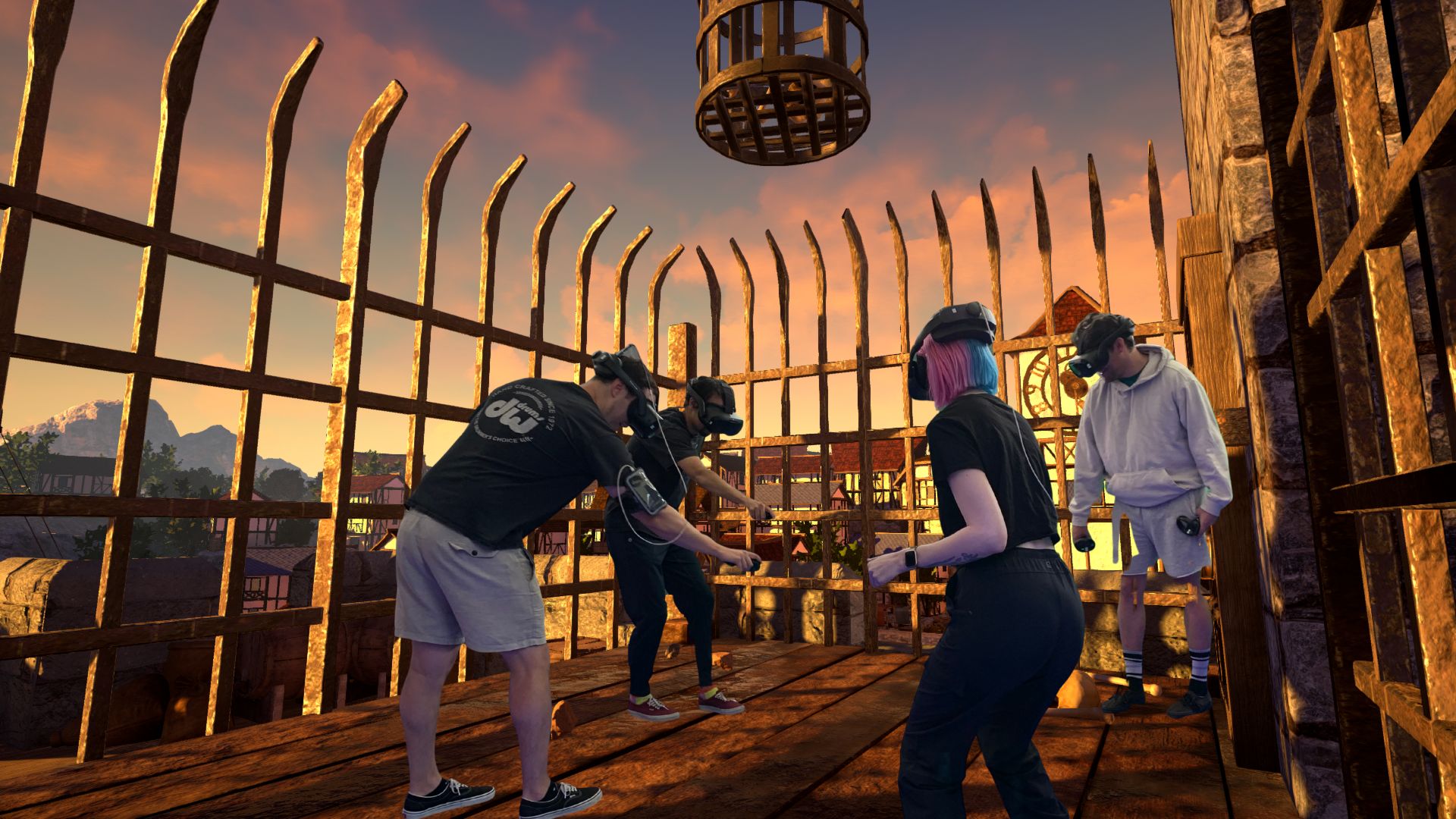
If your group has four or more people, don’t cluster together in one spot. Spread out. Assign different people to different areas of the room or different types of tasks. One person can inventory objects, another can examine wall markings, a third can test interactive elements. You’ll cover more ground in less time, and you’ll avoid the frustrating situation where three people are staring at the same puzzle while a critical clue sits undiscovered in the corner.
4. Don’t Brute Force Puzzles
It’s tempting to try every combination or randomly interact with everything when you’re stuck. Resist that urge. VR escape rooms are designed with logical chains: clue A leads to clue B, which unlocks mechanism C. If a puzzle isn’t working, you’re probably missing a piece of information rather than failing to execute. Step back, ask your team what they’ve found, and look for connections between separate clues.
5. Use Hints Without Guilt
Hints exist because the game designers want you to have fun, not stare at a wall for 15 minutes in frustration. There is absolutely no shame in asking for a hint, and experienced players use them strategically all the time. If your team has been stuck on the same puzzle for more than five minutes with no progress, take the hint. You’ll enjoy the rest of the experience much more than you would have enjoyed another 10 minutes of frustration. Check our FAQ page for more details on how hint systems work during your session.
6. Keep Track of What You’ve Already Used
A common mistake is trying to reuse a clue or key that has already served its purpose. Most well-designed escape rooms follow a “use once” principle: once a code has opened a lock or a key has been used, it’s done. Mentally (or verbally) mark items as “used” so your team doesn’t waste time re-examining solved puzzles.
7. Let Different People Try Different Things
If one person has been wrestling with a puzzle for a few minutes without progress, swap in a fresh set of eyes. Different people notice different things, and what’s invisible to one person might be obvious to another. This isn’t about skill; it’s about perspective. The best teams rotate naturally, and no one takes it personally when someone else spots what they missed.
8. Stay Calm When Time Gets Short
The final five minutes of an escape room create a specific kind of panic that makes smart people do foolish things. Rushing leads to missed clues, poor communication, and frantic button-mashing. If you’re behind on time, take a breath and focus on the most promising lead rather than scattering in every direction. A calm team in the last five minutes accomplishes more than a panicked team in the last ten.
What To Wear
Comfort is the priority. You’ll be standing, walking, crouching, and reaching for the entire session. Wear clothes you can move in freely: athletic wear, jeans and a t-shirt, or anything you’d wear to a casual workout. Closed-toe shoes with good traction are ideal since you’ll be moving around on a smooth floor.
Avoid heavy jewelry, large earrings, or anything that might interfere with the VR headset fitting comfortably. If you wear glasses, don’t worry. Modern VR headsets are designed to accommodate most glasses frames, and the staff will help you adjust the fit before the game starts.
Skip the heavy perfume or cologne. You’ll be in close proximity with your teammates, and VR headsets can trap scents near your face in ways that become distracting.
Motion Sickness: What You Actually Need To Know
Motion sickness in VR happens when your eyes see movement that your body doesn’t feel. The good news: free-roam VR dramatically reduces this problem because your physical movement matches your virtual movement. When you walk forward, you walk forward. There’s no artificial joystick locomotion creating a mismatch between your eyes and your inner ear.
That said, a small percentage of people are more susceptible. If you know you get carsick easily, here are some precautions:
- Eat a light meal 1-2 hours before your session. An empty stomach and a stuffed stomach are both worse than a moderate one.
- Stay hydrated throughout the day leading up to your visit.
- Mention it to the staff. They deal with this regularly and can offer specific adjustments.
- Focus on fixed points in the virtual environment if you start feeling off. Looking at a wall or the floor for a few seconds often resets your equilibrium.
In our experience, the vast majority of first-timers have zero motion sickness issues with free-roam VR. It’s a genuine non-issue for most people, but it’s worth knowing the precautions just in case.
Group Size and Composition Tips
VR escape rooms work well across a range of group sizes, but the sweet spot for most games is 2-6 players. At this size, everyone stays engaged, communication flows naturally, and there’s enough to do without anyone standing around idle.
For larger groups, facilities like ours run staggered sessions so that everyone gets a turn without overcrowding the experience. This actually works well for corporate events and parties because the group that just finished becomes an enthusiastic cheering section for the group going in next.
If you’re booking for a mixed group with different comfort levels (some gamers, some technophobes), don’t stress about it. VR escape rooms are deliberately designed for broad accessibility. The puzzles reward observation, creativity, and communication far more than technical skill or gaming experience. Some of our most successful teams have been groups where nobody had ever worn a VR headset before.
Ready To Try It?
The best preparation for your first VR escape room is simply showing up with an open mind and a willingness to communicate with your team. The technology handles the immersion. The game design handles the challenge. Your job is to talk, explore, and have fun.
Book your VR escape room session and see for yourself why first-timers consistently tell us it was nothing like what they expected, in the best possible way.
Tagged
Experience the Adventure Yourself
Stop reading and start playing! Book your VR experience today.